Why Boat Lift Problems Deserve Immediate Attention
Your boat lift is the first and last line of defense between your vessel and the corrosive saltwater environment of Southwest Florida’s canals and waterways. When something goes wrong with it, the temptation is to keep using it and deal with the issue later — but that approach can turn a minor fix into a costly replacement. Scheduling a proper boat lift repair before the problem compounds is almost always the smarter financial move, and in Cape Coral’s boating-heavy community, a working lift is part of everyday life on the water.
Common Signs Your Boat Lift Is Failing
Knowing what to look for can save you significant time and money. Here are the most frequent warning signs Cape Coral boat owners encounter:
**Uneven lifting or tilting.** If your boat rises at an angle rather than level, one or more of the cables or bunks may be worn, stretched, or misaligned. Continuing to lift under these conditions puts uneven stress on the hull.
**Slow or grinding motor operation.** A boat lift motor that strains, makes grinding noises, or trips its breaker repeatedly is signaling worn gears, a failing capacitor, or moisture intrusion into the motor housing — all common in saltwater environments.
**Frayed or corroded cables.** Galvanized and stainless steel cables both degrade over time in saltwater. Any visible fraying, kinking, or rust streaking down the cable is a sign it needs replacement before it snaps under load.
**Loose or corroded hardware.** Bolts, sheaves, and pulleys that show heavy oxidation or have worked themselves loose can fail suddenly, especially during the dynamic loading that happens when a boat is raised or lowered in choppy water.
**Cradle bunks that are cracked or waterlogged.** Carpeted or PVC-wrapped bunks that have deteriorated won’t support the hull evenly, leading to pressure points that can damage fiberglass over time.
The Southwest Florida Factor: Why Saltwater Accelerates Damage
Cape Coral sits at the heart of one of the most extensive canal systems in the world, and nearly all of those canals connect to saltwater. Salt air and saltwater are extraordinarily corrosive to the metals, motors, and hardware that make up a boat lift. What might last fifteen years in a freshwater lake environment can show serious wear in five to seven years here.
Summer storm season adds another layer of stress. High winds, surge, and debris loading during tropical weather events can bend lift frames, snap cables, and damage motors in a single storm. Many Cape Coral boat owners discover lift damage only when they try to use the lift after a storm has passed — often right when they’re eager to get back on the water.
Why Mobile Marine Mechanics Are a Practical Choice for Lift Repairs
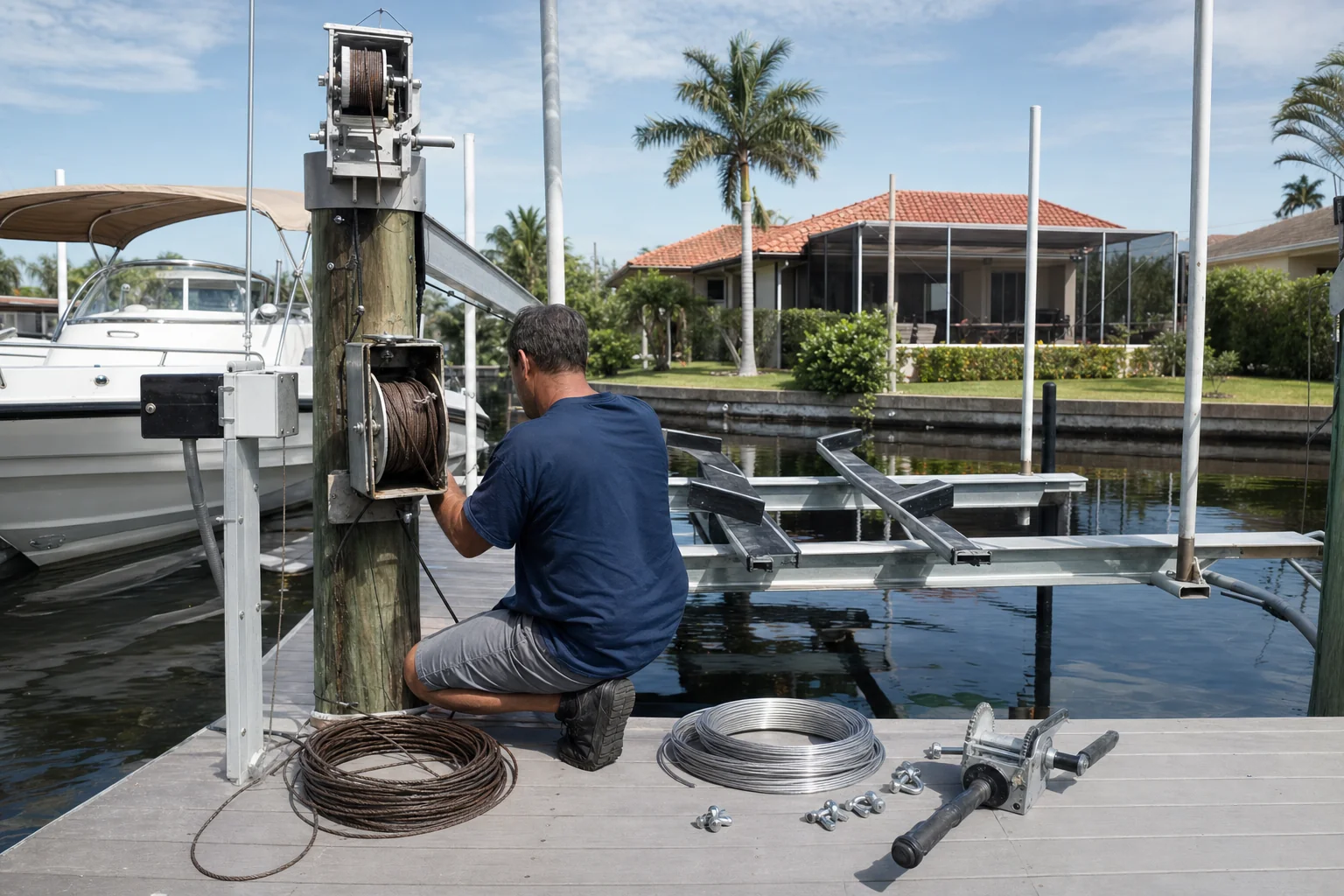
Traditional marine service shops require you to haul your boat off the lift, transport it, and wait in a queue — which doesn’t make sense when the problem is the lift itself, not the boat. Mobile marine mechanics travel directly to your dock or canal-side property to assess and repair lift components on-site. This approach eliminates hauling costs and gets the diagnosis done in the actual environment where the lift operates.
For Cape Coral homeowners with direct-access canal lots, this is especially convenient. A technician can inspect the motor, test the electrical circuit, examine cables under load, and replace worn components without your boat ever leaving the property. Many straightforward repairs — cable replacement, motor capacitor swaps, bunk refurbishment, and hardware tightening — can be completed in a single visit.
What a Proper Boat Lift Inspection Should Cover
If you call a mobile marine mechanic for a lift evaluation, here’s what a thorough inspection should include:
- **Electrical system check:** Verify the motor amperage draw, inspect wiring for chafe or corrosion, and test the control switch and any remote systems.
- **Cable and sheave inspection:** Examine every inch of cable for fraying, check sheave bearings for smooth rotation, and confirm proper cable seating in all grooves.
- **Structural frame assessment:** Look for bent or cracked frame members, loose welds, and any signs of galvanic corrosion at connection points.
- **Bunk and cradle review:** Confirm the bunks are properly positioned for the hull shape, that carpeting or PVC wrap is intact, and that the cradle sits level.
- **Load test:** Raise and lower the boat through a full cycle while observing motor performance, cable tension, and lift levelness.
Staying Ahead of Lift Problems Year-Round
The best strategy for Cape Coral boat owners is a proactive one. Having your lift inspected at least once a year — ideally before peak boating season in the spring — catches developing problems before they become emergencies. After any significant storm, a post-weather inspection is worth scheduling even if the lift appears to be working normally, since hidden structural stress can worsen quickly with regular use.
A well-maintained boat lift protects your vessel, preserves your dock investment, and keeps you on the water when you want to be — which in Southwest Florida, is most of the year.